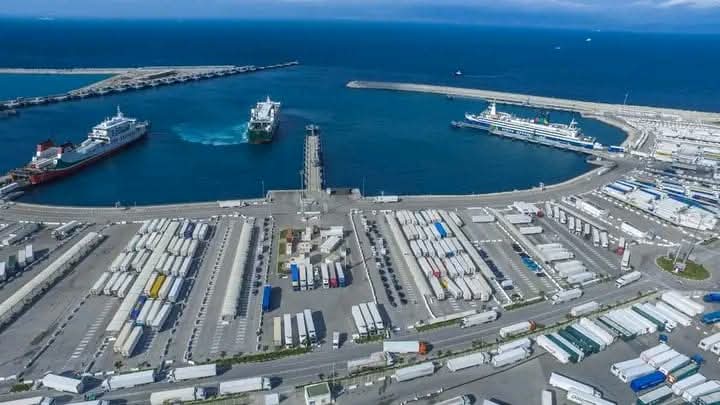
Casablanca – A tanker carrying approximately 40,000 tons of Russian ultra-low-sulfur diesel is heading toward Morocco, highlighting changes in international petroleum trade as governments and fuel suppliers respond to high prices, geopolitical tensions and uncertainty surrounding maritime energy routes. The shipment, loaded on October 13 at the Russian port of Primorsk on the Baltic Sea, comes as Moscow resumes diesel exports following a partial easing of restrictions and Washington relaxes certain limitations on transactions involving Russian-origin fuel.
The cargo was identified as heading toward Morocco in maritime tracking data from the London Stock Exchange Group, cited by Reuters. However, the importing company, the intended Moroccan port of discharge, the commercial value of the shipment and its ultimate destination have not been disclosed. It remains unclear whether the diesel is intended for domestic consumption or will be re-exported to another market.
The shipment comes as Morocco faces renewed pressure from fuel prices. Diesel prices exceeded $1.7 per liter at some filling stations at the beginning of October, with differences across cities and distribution networks. The arrival of Russian supplies raises questions about whether changes in international trade flows could improve purchasing conditions for Moroccan importers and eventually affect prices paid by consumers.
The tanker also illustrates how fuel trade is being reshaped by the interaction of geopolitical agreements, sanctions, supply concerns and the search for alternative sources of petroleum products.
Fuel prices and supply options
Fuel prices remain a major concern for economies that depend heavily on imported petroleum products. In Morocco, international price movements can influence transport costs, logistics, agricultural production and household expenditure. Changes in the cost of imported diesel can therefore have consequences beyond the fuel market itself.
Morocco relies on international suppliers for its petroleum product requirements, leaving domestic prices exposed to movements in global oil markets, refining margins, shipping costs and currency fluctuations. Since fuel prices were liberalized at the end of 2015, distribution companies have determined retail prices rather than relying on a uniform government-fixed price.
In this context, importers have an incentive to compare offers from different suppliers and seek competitive purchasing terms. Russian diesel may provide an additional option, particularly when international trade restrictions are relaxed and exporters seek to regain access to markets.
Nevertheless, a large shipment does not automatically translate into lower prices at Moroccan filling stations. The final cost depends on the price negotiated for the cargo, freight and insurance expenses, financing, storage, port handling, distribution margins and the timing of the purchase. The impact also depends on the volume of Russian fuel entering the market relative to Morocco’s total demand.
The 40,000-ton cargo could contribute to supply diversification, but its commercial significance cannot be fully assessed without information about its buyer, contractual terms and final destination.
Middle East tensions
Geopolitical instability in the Middle East provides another important context for the changing international fuel market. Conflicts involving regional powers and disruptions to maritime transport can increase uncertainty over the availability and cost of oil and petroleum products, even when production remains sufficient to meet immediate demand.
The Strait of Hormuz is particularly important because it connects the Persian Gulf with the Gulf of Oman and the wider Indian Ocean. A substantial share of global oil trade passes through this narrow maritime corridor, including crude oil and petroleum products exported by major Gulf producers.
Any interruption to shipping through the strait, whether caused by military escalation, security threats, vessel restrictions or a temporary closure, can affect energy markets. Buyers may face higher freight and insurance costs, longer delivery times and uncertainty over whether contracted cargoes will arrive as scheduled. The possibility of disruption can also raise international prices before an actual shortage develops, as traders account for the risk of reduced supplies.
These risks encourage importing countries and commercial buyers to maintain alternative supply arrangements. Access to fuel from producers outside the Gulf can help diversify sourcing options and reduce dependence on particular routes, although the degree of protection depends on the origin of the fuel, shipping routes and the structure of individual contracts.
Russia’s Baltic Sea export terminals offer a different maritime route from the Strait of Hormuz. Russian diesel shipped from Primorsk does not need to pass through the strait to reach the Atlantic shipping network and, subsequently, markets in Europe, North Africa or elsewhere. This geographical difference can make such cargoes commercially relevant when buyers are concerned about disruptions affecting Gulf exports.
However, an alternative route does not eliminate exposure to global price movements. Petroleum products are traded in interconnected markets, meaning that a disruption in one region can affect prices elsewhere even when supplies are sourced from another location. The Russian cargo’s actual contribution to Morocco’s energy security will depend on whether it reaches the domestic market and on the availability of additional shipments.
Russia resumes exports
The tanker is also part of a wider change in Russia’s petroleum trade. Following the Russia-Ukraine war, Western sanctions and the European Union’s restrictions on seaborne imports of Russian petroleum products altered established trade relationships. Russia increasingly sought buyers in alternative markets across Asia, Africa and other regions, while importers adjusted their purchasing strategies to account for sanctions, shipping arrangements and price differences.
Russia subsequently introduced restrictions on certain diesel exports to protect domestic availability and manage its internal fuel market. Those measures were extended beyond their initial timetable, with the ban previously scheduled to remain in place until the end of January 2027.
On October 10, Russia partially relaxed its restrictions on diesel exports, allowing some shipments to resume. The change coincided with a US authorization permitting specified transactions involving Russian-origin diesel.
The US decision came amid discussions between Washington and Moscow over fuel supplies to international markets. US President Donald Trump said Russia had agreed to supply diesel to global markets with the stated objective of helping ease fuel price pressures.
The timing connects the Moroccan-bound shipment to broader efforts to restore fuel flows and increase available supplies. Nevertheless, the exact contractual relationship between the cargo and the US-Russia understanding has not been established publicly. The shipment’s movement demonstrates renewed export activity, but it does not by itself establish the terms of any bilateral agreement or the precise reasons behind the buyer’s decision.
Export volumes
Russia’s ability to increase diesel exports could influence international supply conditions in the coming months. Russian officials have indicated that monthly exports could return to between 3 million and 3.5 million tons by the end of 2026, bringing shipments closer to customary levels.
Achieving that target would depend on the volume of fuel available for export, domestic consumption requirements, refining operations, logistics and the continued implementation of revised restrictions. It would also depend on whether buyers and shipping companies can complete transactions within the applicable legal and commercial frameworks.
For international buyers, the return of additional Russian diesel could increase the number of available offers and intensify competition among suppliers. The effect on prices, however, would depend on the scale and consistency of the new flows, demand in importing countries, refinery output and conditions in other major producing regions.
The Russian export recovery is therefore taking place within a complex market in which supply decisions are influenced by both commercial calculations and government policies. High prices can encourage buyers to seek cheaper cargoes, while geopolitical agreements and regulatory changes determine which transactions can proceed.
Morocco’s previous imports
Morocco has previously increased its purchases of Russian diesel. In 2023, imports rose as international petroleum trade underwent major changes following the Russia-Ukraine war and European restrictions on seaborne imports of Russian petroleum products. As Russian suppliers searched for alternative buyers, markets in North Africa became part of the reconfigured trade network.
Data published by the US Energy Information Administration in May 2024 showed that Morocco, Libya, Tunisia and Ghana each recorded an increase of more than 20,000 barrels per day in annual seaborne imports of Russian diesel during 2023 compared with the previous year.
These developments established a precedent for Morocco’s participation in the changing market for Russian petroleum products. The current shipment comes amid another period of uncertainty, shaped by high retail fuel prices, concerns over Middle East shipping routes and changes in the regulatory environment surrounding Russian exports.
The renewed availability of Russian diesel could provide Moroccan importers with another purchasing option and potentially improve their negotiating position when comparing offers from international suppliers. However, the actual benefit would depend on prices, shipping expenses, payment terms and the reliability of future deliveries.
Impact on prices
Whether the new cargo will ease fuel costs in Morocco remains uncertain. The country may benefit if importers secure diesel at competitive prices and if the savings exceed additional transport, insurance, handling and financing costs. Any effect on retail prices would also depend on distribution companies’ pricing decisions and the evolution of international benchmarks.
The uncertainty surrounding the shipment’s buyer and destination makes it particularly difficult to estimate its immediate contribution to domestic supply. Morocco’s designation in maritime tracking data does not necessarily prove that the fuel will be sold to Moroccan consumers.
The longer-term significance will depend on whether the cargo is followed by regular deliveries, whether Moroccan importers can negotiate favorable contracts and whether alternative suppliers remain commercially competitive. Continued access to multiple sources could give buyers greater flexibility when geopolitical tensions disrupt established supply routes.
The 40,000-ton tanker therefore reflects a broader adjustment in global energy trade rather than a confirmed reduction in Moroccan fuel prices. The combination of high prices, Middle East tensions, potential disruptions in the Strait of Hormuz and the partial reopening of Russian export channels has increased the importance of supply diversification.
For Morocco, the key question is whether these changes can translate into more competitive import costs and more reliable fuel availability. The shipment offers a concrete example of how geopolitical developments and commercial decisions are intersecting, while its direct effect on the domestic market will depend on the final destination of the cargo, the terms of the transaction and the continuity of future supplies.