Casablanca – Morocco’s Marsa Maroc recorded consolidated revenue of approximately $502 million during the first nine months of 2026, representing a 13.1% increase compared with the same period a year earlier. The growth was supported by higher cargo volumes, stronger performances at several ports and the expanding contribution of logistics services beyond traditional port handling, as the group continued to invest in new infrastructure and strengthen its portfolio of concessions.
The results reflect the group’s efforts to diversify its activities while increasing its operational capacity across Morocco’s maritime transport network. Its development strategy combines investments in existing terminals, the acquisition of new port concessions and preparations for the commissioning of additional facilities, particularly at Nador West Med.
Revenue during the third quarter alone reached approximately $171 million, compared with around $151 million during the corresponding period in 2025. This represented an increase of approximately 13.2% year on year.
The ports of Nador-Beni Ensar and Agadir contributed to the group’s revenue growth, alongside the increasing contribution of complementary logistics activities. These include coastal shipping, known as cabotage, and inland logistics services, which extend the group’s operations beyond cargo handling within port terminals.
The development of these activities forms part of a gradual diversification strategy intended to broaden revenue sources and strengthen the group’s position across different stages of the logistics chain. Rather than relying exclusively on terminal operations, Marsa Maroc is expanding its involvement in services connecting maritime transport with inland distribution and commercial exchanges.
Cargo handled by the group reached 51.6 million tonnes between January and September 2026, representing a 2% increase compared with the same period in 2025. The improvement was mainly driven by higher volumes of solid and liquid bulk cargo, as well as continued growth in import-export container traffic.
Container handling remained broadly stable at 2,272,299 twenty-foot equivalent units (TEUs), up 0.1% year on year. However, the overall figure concealed different developments across the group’s container activities.
Import-export traffic increased by 4% to 1,023,247 TEUs, while transshipment volumes declined by 2.9% to 1,249,052 TEUs. The increase in import-export operations therefore compensated for the decrease in transshipment activity, keeping total container volumes almost unchanged.
This development reflects the growing specialization of Marsa Maroc’s terminals. Container facilities at Casablanca port are increasingly prioritizing import-export flows, while the terminal operated by Tanger Alliance remains primarily dedicated to transshipment operations. This division allows the group to adapt its terminals to different commercial requirements and operational patterns.
Other cargo categories also recorded increases during the reporting period. Solid bulk and general merchandise volumes reached approximately 17.6 million tonnes, representing growth of 3.3%. Liquid bulk traffic amounted to around 8.8 million tonnes, up 1.9%.
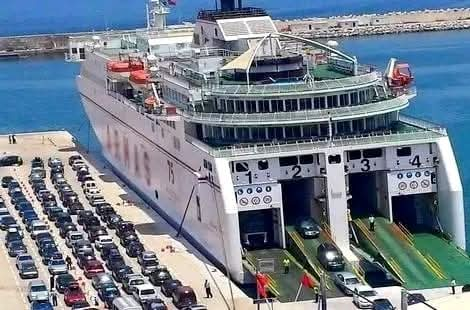
The group’s activity also benefited from growth in vehicle and roll-on/roll-off operations. Marsa Maroc handled approximately 119,000 new vehicles during the first nine months of the year, an increase of 8.7%. Roll-on/roll-off international road transport traffic reached 22,500 units, up 13.9% compared with the corresponding period in 2025.
These figures indicate that growth was distributed across several operational segments, although container traffic remained broadly stable. The expansion of bulk cargo, vehicle handling and complementary logistics services contributed to the group’s overall revenue performance.
Alongside its operational results, Marsa Maroc continued to strengthen its portfolio of port concessions through agreements involving Casablanca and Jorf Lasfar.
One of the most significant developments was the 20-year extension of the concession for Container Terminal 3 at Casablanca port, known as TC3PC. The agreement is accompanied by an investment programme worth approximately $309 million.
The programme aims to increase the group’s total container-handling capacity at Casablanca port to more than 2 million TEUs by 2030, approximately double its current capacity. The planned expansion is intended to accommodate growing trade volumes and reinforce the port’s ability to handle additional import and export traffic.
Casablanca is an important gateway for Morocco’s international trade, making additional terminal capacity relevant to the country’s broader efforts to improve maritime logistics and support commercial exchanges. The extension also provides Marsa Maroc with a longer operating horizon for its investment and development plans at the port.
The group also secured the concession for oil berth 8 Bis at Jorf Lasfar port. The facility will have a handling capacity of 4.6 million tonnes and is scheduled to enter service during the first quarter of 2029. Its development will expand the group’s presence in liquid bulk operations and add new capacity to the infrastructure available at one of Morocco’s major industrial and commercial ports.
Investment spending increased substantially during the first nine months of 2026. Marsa Maroc’s consolidated investments reached approximately $411 million, compared with around $184 million during the same period a year earlier. This represented an increase of 123.2%.
The expenditure was primarily directed towards developing port-handling capacity and purchasing equipment for the new terminals at Nador West Med. These investments are part of the group’s preparations to operate additional facilities and expand its presence in Morocco’s evolving port network.
Nador West Med is particularly relevant to this strategy because it is expected to provide additional capacity for container handling and other maritime activities. The acquisition of equipment and development of operational infrastructure are necessary steps before the new terminals can reach their intended commercial capacity.
The group’s investment programme has also influenced its financial position. At September 30, 2026, consolidated net debt stood at approximately $32.5 million, compared with a positive net cash position of around $48.5 million at the end of September 2025.
This change occurred as Marsa Maroc continued to finance its expansion projects and mobilize additional resources. Financing drawdowns during the period reached approximately $138 million for subsidiary WMCT and $71 million for Marsa Maroc SA.
At the end of September 2026, the group’s financing debt amounted to approximately $331 million, while available cash and cash equivalents stood at around $298 million.
The difference between financing debt and available cash is consistent with the reported consolidated net debt position, reflecting the financial resources committed to the group’s ongoing development programme.
Marsa Maroc’s performance during the first nine months of 2026 therefore combines revenue growth with a significant acceleration in capital expenditure. The increase in turnover was supported by several cargo categories and the expansion of logistics services, while new concessions and infrastructure projects are intended to provide additional operating capacity over the coming years.
The group’s priorities include expanding container operations in Casablanca, developing liquid bulk capacity at Jorf Lasfar and preparing new terminals at Nador West Med. These projects will determine how effectively Marsa Maroc converts its current investment spending into additional capacity and sustained revenue growth as Morocco continues to expand its port infrastructure and strengthen its position in international maritime trade.