


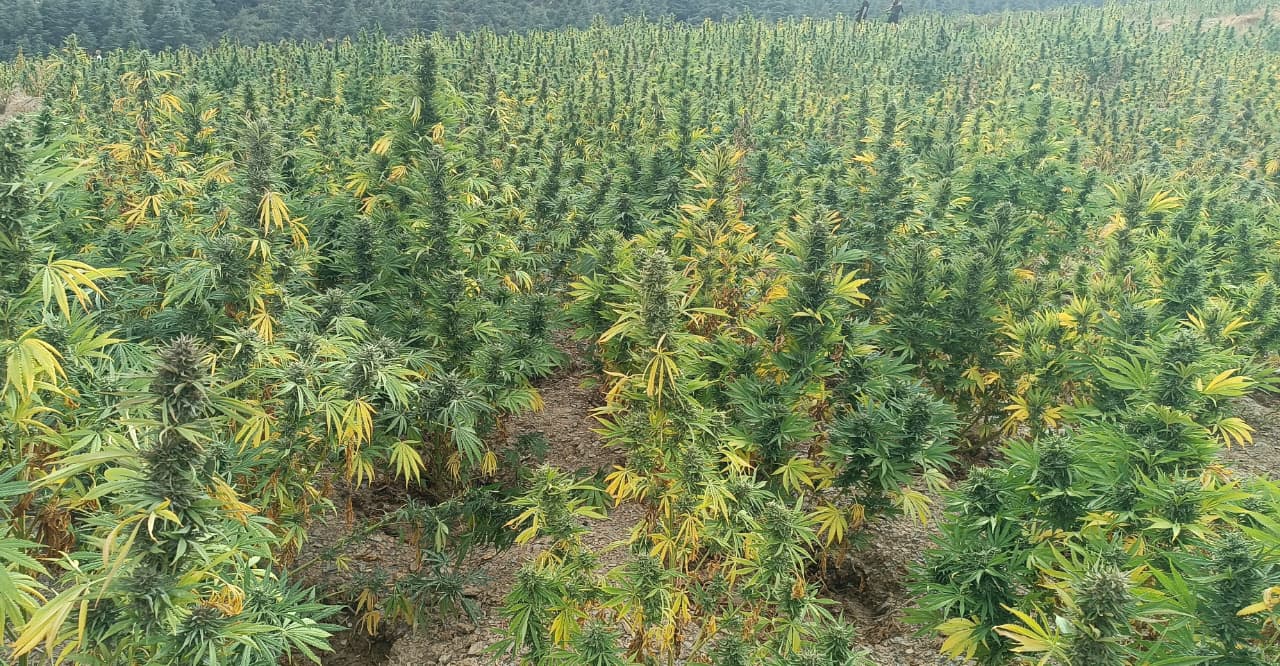


Casablanca – Morocco has recorded a substantial decline in illegal cannabis cultivation over the past two decades, with the area devoted to unauthorised production falling from approximately 134,000 hectares in 2003 to 15,496 hectares in 2026, representing a reduction of 88.43%. The figures, reported by the Ministry of the Interior, reflect the combined impact of security operations, rural development programmes, awareness campaigns and the gradual development of a regulated cannabis sector.
The reduction is part of Morocco’s broader efforts to limit the supply of illicit drugs while addressing the economic and social conditions that have historically encouraged cannabis cultivation in certain rural areas. Rather than relying exclusively on enforcement measures, the authorities have increasingly combined field monitoring with initiatives intended to provide farmers and local communities with alternative sources of income.
According to the Ministry of the Interior’s 2026 annual activity report, provincial committees responsible for combating illegal cannabis cultivation have played an important role in reducing cultivated areas. Their work includes regular field operations, monitoring agricultural activities and tracking changes in cultivation patterns in the regions concerned.
The decline from 134,000 hectares to fewer than 16,000 hectares illustrates the scale of the transformation. However, the authorities’ approach increasingly recognizes that reducing illegal production requires more than restricting agricultural activity. It also depends on improving local economic conditions and creating viable alternatives for households that have traditionally relied on cannabis farming.
Rural development and alternative sources of income
One of the main elements contributing to the reduction has been the expansion of programmes supporting income-generating activities and alternative agricultural production. These initiatives seek to improve living conditions in rural communities and reduce their dependence on illegal cannabis cultivation.
The Ministry of the Interior has identified the development of alternative crops as an important part of this strategy. By encouraging farmers to diversify their agricultural activities, the authorities aim to provide more sustainable income opportunities while gradually reducing the economic importance of unauthorised cannabis production.
The National Initiative for Human Development (INDH) has also contributed to this process by supporting projects designed to create alternative employment opportunities. Such programmes are particularly relevant in rural areas where employment options remain limited and agricultural activity represents a major source of household income.
The challenge is to ensure that alternative activities can generate sufficient and relatively stable earnings to compete with the income historically obtained from illegal cannabis cultivation. This requires investment in agricultural infrastructure, access to markets, technical support and the development of local economic activities.
Awareness campaigns have also formed part of the government’s response. Provincial committees and other relevant institutions have continued information and prevention initiatives in local markets, villages and rural communities. These campaigns seek to explain the legal framework, inform farmers about available alternatives and encourage a gradual transition towards authorised economic activities.
The combination of enforcement, economic support and public awareness reflects an approach that considers the social and economic dimensions of the issue alongside its security implications.
Legal cannabis framework creates a new agricultural pathway
The implementation of Law 13.21, which regulates the legal uses of cannabis in Morocco, has introduced another dimension to the country’s strategy. The legislation provides a framework for authorised cultivation, production, processing and commercialization, encouraging farmers to move away from illegal activities and participate in a regulated economic sector.
Under this framework, cannabis can be cultivated and processed for legally authorised purposes, including the extraction of cannabidiol (CBD), a non-intoxicating compound used in certain cosmetic and other products. The law also creates opportunities for the development of food and cosmetic preparations derived from the plant, subject to the applicable regulatory requirements.
The transition towards legal production is intended to give farmers access to formal economic opportunities while allowing the authorities to exercise greater control over cultivation, processing and distribution. It also creates possibilities for developing agricultural cooperatives, processing activities and commercial partnerships.
The emergence of this regulated sector could gradually change the economic structure of cannabis-producing areas, particularly in northern Morocco, where traditional cultivation has historically represented an important source of income for some communities.
However, the development of legal cannabis activities depends on several conditions, including access to authorised buyers, compliance with production standards, the availability of processing facilities and the ability of farmers to obtain satisfactory returns. The long-term success of the framework will therefore depend on whether legal activities can provide sufficiently attractive economic opportunities to encourage wider participation.
Security operations remain an important part of the strategy
Alongside the reduction in illegal cultivation, the Ministry of the Interior continues to strengthen operations against drug trafficking and international smuggling networks.
By the end of August 2026, security interventions had resulted in the seizure of more than 274 tonnes of cannabis resin, over 53 tonnes of cannabis plants, 2,956 kilograms of cocaine, 116 grams of heroin and 856,102 psychotropic pills.
These operations also led to the dismantling of several criminal networks involved in international drug trafficking. Security forces seized vehicles and equipment used in smuggling activities, including trucks, passenger cars, international freight vehicles, high-speed boats, recreational vessels and jet skis.
The authorities have also increased surveillance along the country’s coastlines and land borders, while strengthening controls at border crossing points through modern investigation, monitoring and detection technologies.
The ministry has emphasised the importance of improving coordination between security agencies through faster intelligence sharing and more extensive cooperation. Training programmes and exchanges of expertise are also intended to strengthen the ability of security services to respond to changing trafficking methods, including the emergence of substances that are not covered by international control mechanisms.
Psychotropic pills have become another area of concern, particularly because of their potential impact on young people. The government has therefore combined enforcement measures with awareness campaigns, civil society involvement and efforts to improve access to treatment and rehabilitation services for drug users.
A transition that requires sustained economic support
Morocco’s reduction in illegal cannabis cultivation represents a significant change in the scale of agricultural activity associated with the illicit market. Nevertheless, the remaining cultivated area of approximately 15,496 hectares indicates that the transition is still underway.
The next challenge will be to consolidate the progress achieved while ensuring that rural communities are not left without viable economic alternatives. Enforcement operations can restrict illegal production, but maintaining a lasting reduction will also require continued investment in agriculture, infrastructure, education, vocational training and employment opportunities.
The development of authorised cannabis activities offers one possible source of economic diversification, but it is not the only alternative. Supporting other agricultural products, improving access to markets and encouraging small businesses can also help reduce dependence on illegal cultivation.
For Morocco, the issue therefore extends beyond drug control. It involves managing an economic transition in rural areas, integrating farmers into formal production channels and creating conditions under which legal activities can gradually replace unauthorised ones. The 88.43% decline recorded between 2003 and 2026 provides an indication of the progress made through this combination of policies. Whether the reduction can be sustained will depend on the continuity of field operations, the effectiveness of rural development programmes and the capacity of the legal cannabis sector to generate tangible benefits for farmers and local communities.


