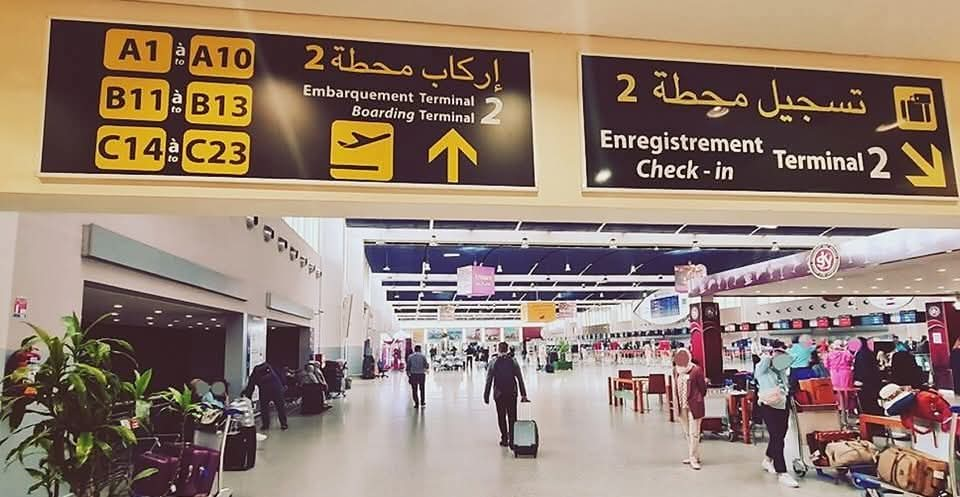
Casablanca – Casablanca’s airport system closed 2025 with a marked surge in arrivals, reflecting a broader acceleration in Morocco’s air traffic driven by major international events, expanding air connectivity, and sustained growth in travel demand. At the center of this dynamic stands Mohammed V International Airport, the country’s main aviation hub, which experienced one of the strongest years in its history in terms of passenger volumes and operational intensity.
According to official data released by the National Airports Office (ONDA), passenger traffic at Mohammed V Airport exceeded 11 million travelers during 2025, a symbolic and strategic threshold reached for the first time. By year-end, total traffic stood at approximately 11.5 million passengers, up from 10.5 million in 2024, representing an annual increase of 9.3%. This growth was particularly visible in international arrivals, which rose sharply during peak periods linked to major events and reinforced air links.
The surge in arrivals was largely driven by the Africa Cup of Nations (AFCON 2025), hosted by Morocco, which generated exceptional travel flows into Casablanca. As the country’s main point of entry, Mohammed V Airport absorbed a significant share of incoming passengers, including football supporters from across Africa and Europe, official delegations, national teams, international media, and tourists combining sports travel with leisure stays. During the tournament, Casablanca became a convergence point for continental and intercontinental traffic, placing unprecedented pressure on airport operations.
Beyond the tournament effect, the rise in arrivals also reflects structural changes in air connectivity. Over the past year, airlines have strengthened their networks serving Casablanca, increasing frequencies on existing routes and launching new connections to destinations in Africa, Europe, and other regions. These additions have improved accessibility to Morocco’s economic capital and reinforced its role as a transfer hub, particularly for African routes linking north, west, and central Africa with Europe and the Middle East.
Casablanca’s airports now account for around 31% of total passenger traffic across Morocco, underlining the city’s dominant position within the national aviation landscape. This share highlights not only the scale of demand but also the concentration of international arrivals through Mohammed V Airport, which continues to function as the primary gateway for business travel, tourism, and the Moroccan diaspora.
Operationally, the rise in arrivals translated into sustained high activity levels throughout the year. While AFCON 2025 generated sharp weekly and monthly peaks linked to match schedules and tournament phases, traffic data show that growth extended beyond these spikes. Business travelers, tourists, and residents contributed to steady inflows, suggesting that the increase is not solely attributable to a one-off event but also to underlying demand fundamentals.
The strong performance of Casablanca’s airports fits within the broader framework of Morocco’s “Airports 2030” strategy, which aims to modernize airport infrastructure, expand capacity, and enhance passenger experience nationwide. In Casablanca, this strategy has involved continuous investments in terminals, security and border control systems, digital services, and passenger flow management, all of which proved critical during periods of intense arrivals.
ONDA has indicated that Mohammed V Airport is preparing for further growth in the coming years. Projections point to traffic reaching around 12.5 million passengers as early as 2026, with longer-term ambitions exceeding 20 million passengers by 2030. These forecasts are based on expected increases in international travel, the continued expansion of air routes, and Morocco’s growing role as a host for large-scale international events.
The ability of Casablanca’s airports to manage the 2025 surge in arrivals without major operational disruptions has reinforced confidence in the resilience of Morocco’s aviation infrastructure. High volumes were handled while maintaining operational continuity, safety standards, and acceptable levels of passenger flow, despite the exceptional pressures associated with AFCON 2025.
From an economic perspective, the increase in arrivals has had spillover effects across multiple sectors, including tourism, transport services, hospitality, and trade. Casablanca’s position as both an arrival destination and a transit hub amplifies these impacts, as international passengers contribute not only through direct spending but also through business activity and regional connectivity.
Looking ahead, the surge in arrivals recorded in 2025 is increasingly seen as a turning point rather than an isolated peak. It signals Casablanca’s transition into a higher traffic bracket and confirms its strategic role within Africa’s evolving air transport network. As Morocco prepares for future international milestones, including major sporting and economic events later in the decade, Casablanca’s airport are expected to remain at the forefront of this expansion.
In this context, the performance of Mohammed V Airport in 2025 serves as both a benchmark and a stress test. It demonstrated the capacity of Casablanca’s aviation infrastructure to absorb rapid increases in arrivals while laying the groundwork for sustained growth in international air traffic over the years ahead.