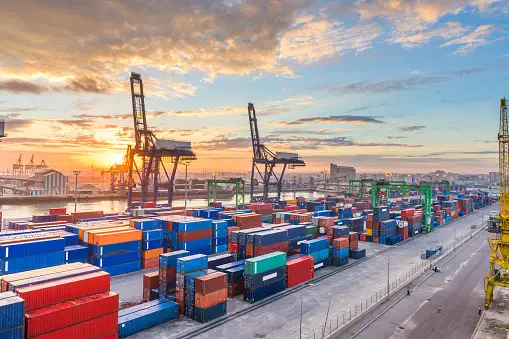
Casablanca – Morocco is preparing to enter a new phase in its port and industrial development with the upcoming launch of the Nador West Med complex, scheduled to begin operations in the fourth quarter of 2026. Designed as an integrated port, industrial, logistics, and energy platform, the project is positioned to play a central role in reshaping the country’s economic geography, strengthening logistics sovereignty, and accelerating regional development, particularly in the northeastern part of the Kingdom.
With total investments reaching approximately $5.26 billion, funded through a combination of public and private contributions, Nador West Med stands among the largest infrastructure projects in Morocco’s modern history. Authorities view the complex as a strategic extension of the national port system, complementing the role played by Tanger Med on the Mediterranean, while diversifying access points for trade flows and reducing pressure on existing corridors.
A port with regional and global reach
Located about 130 nautical miles from the Strait of Gibraltar, Nador West Med occupies a highly strategic position along major maritime routes linking Europe, Africa, the Mediterranean basin, and the Atlantic Ocean. This geostrategic location is expected to allow the port to capture significant international trade volumes and serve as a redistribution hub for regional and transcontinental traffic.
Unlike traditional ports focused mainly on transshipment, Nador West Med has been designed from the outset as a multifunctional platform that integrates port operations with industrial production, logistics services, and energy infrastructure. This integrated model reflects a broader national strategy aimed at transforming maritime flows into local economic value, employment, and industrial output.
World-class port infrastructure
The core port infrastructure has already been completed, including 5.4 kilometers of protective breakwaters, 4 kilometers of quays, and four dedicated energy berths. Two container terminals have been concessioned to international operators and are set to enter service progressively starting in 2026.
The first container terminal, with a quay length of 1,520 meters, will begin operations with an annual capacity of 3.5 million TEUs. A second terminal, measuring 900 meters, is scheduled to come online in 2027, adding a further 1.8 million TEUs. At launch, the port’s total container handling capacity will reach approximately 5 million TEUs, with long-term expansion potential of up to 17 million TEUs.
Beyond container traffic, the port will include a general cargo terminal with a 540-meter quay and an annual capacity of 3 million tons, as well as a solid bulk terminal with a 360-meter quay capable of handling up to 7 million tons per year. These facilities are expected to become operational in 2027, ensuring a diversified port offering capable of accommodating a wide range of cargo types.
A major energy platform
A defining feature of Nador West Med is its energy dimension. The complex will host Morocco’s first liquefied natural gas (LNG) terminal, with an annual capacity of 5 billion cubic meters. In parallel, a hydrocarbons terminal will be developed, supported by large-scale storage infrastructure capable of processing up to 25 million tons per year.
These energy facilities are expected to enter service starting in 2027 and are designed to enhance national energy security, diversify supply sources, and provide a reliable energy base for industrial users. Authorities also highlight the role of these installations in supporting the decarbonization of maritime transport and facilitating energy transition objectives.
In line with sustainability goals, the complex will be supplied partly by renewable energy generated from wind and solar resources available in the Oriental region, reinforcing the project’s environmental dimension.
An industrial and logistics ecosystem
Beyond the port perimeter, Nador West Med includes the development of large-scale industrial and logistics zones. The first phase covers 700 hectares, supported by public investment of approximately $330 million, while private investors have already committed around $928 million to industrial projects within the site. Long-term plans allow for potential expansion of the zones to several thousand hectares.
These areas are intended to attract high value-added industries across sectors such as energy, manufacturing, logistics services, ship-related activities, and industrial processing. By linking production directly to port infrastructure, the project aims to shorten supply chains, reduce logistics costs, and improve Morocco’s overall industrial competitiveness.
Connectivity is a central component of this strategy. A dedicated investment envelope of approximately $1.44 billion has been allocated to rail, road, highway, and electrical connections, ensuring seamless integration of the complex into national transport and energy networks.
Employment and regional development impact
The social and economic impact of Nador West Med is expected to be substantial. In the short term, the project is projected to generate around 14,000 direct jobs. By 2035, this figure could reach 50,000 direct jobs, complemented by approximately 90,000 indirect jobs across supply chains, services, and related industries.
Authorities emphasize that the project is not only an economic initiative but also a territorial development tool. Vocational training programs and skills development initiatives are being implemented to prepare local youth for employment opportunities within the port, industrial, and logistics activities. Parallel investments in urban and social infrastructure aim to improve living conditions across the provinces within the port’s area of influence.
Strong investor confidence
To date, confirmed private investments linked to the complex amount to approximately $2.06 billion, reflecting strong confidence from leading international maritime, industrial, and energy operators. This level of engagement underscores the project’s economic credibility and long-term growth potential.
Observers note that the Oriental region, historically less industrialized than other parts of the Kingdom, is now emerging as a strategic destination for domestic and foreign investors, driven in part by the scale and integrated nature of the Nador West Med project.
A new pillar of the national port system
With Nador West Med, Morocco is reinforcing a national port architecture built around complementary and specialized hubs. In the north, Tanger Med and Nador West Med form a Mediterranean duo with strong international orientation. In central regions, ports such as Casablanca, Jorf Lasfar, and Mohammedia ensure industrial, commercial, and energy continuity. In the south, Dakhla Atlantique supports the Kingdom’s African outlook.
This coordinated system is designed to optimize trade flows, secure supply chains, enhance energy security, and strengthen national economic sovereignty.
As its operational launch approaches, Nador West Med is increasingly viewed not simply as a port, but as a multifunctional development platform combining logistics performance, industrial transformation, energy security, and territorial integration. Its entry into service in late 2026 is expected to mark a significant milestone in Morocco’s long-term strategy to position itself as a regional hub at the crossroads of Europe, Africa, and the Mediterranean.