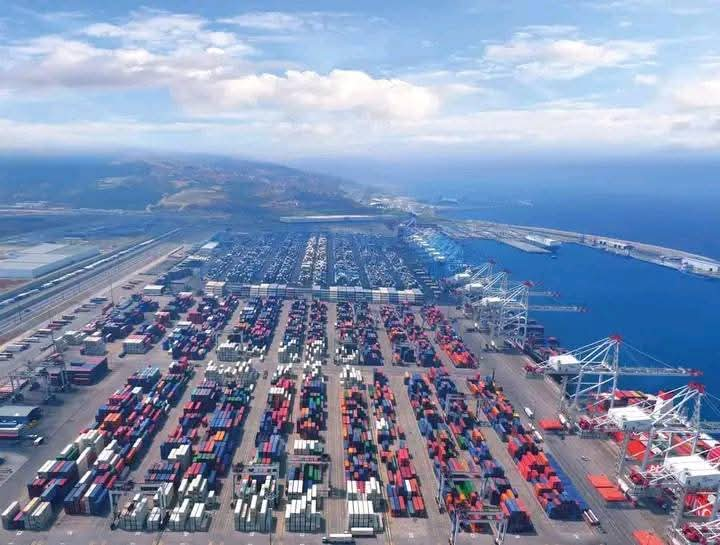


Casablanca – The Dakhla Atlantique Port, one of Morocco’s most ambitious infrastructure projects, is steadily progressing toward its goal of becoming a major commercial and industrial hub on the southern Atlantic coast. According to recent updates from project authorities, construction works have now reached approximately 46% completion, marking a significant milestone for a port that is expected to play a central role in Morocco’s economic strategy for the southern provinces.
A cornerstone of national and regional strategy
The port is designed as a multifunctional deep-water facility with an initial capacity of 35 million tons per year, covering container traffic, liquid and dry bulk, hydrocarbons, seafood, mining products, and renewable energy components. This large-scale capacity positions Dakhla Atlantique as a key gateway for Morocco’s trade relations with West Africa, the Sahel, Europe, and the Americas. Moreover, the port will serve as a platform for emerging sectors such as green hydrogen, highlighting its role in supporting Morocco’s sustainable energy ambitions.
The project aligns with Morocco’s National Port Strategy 2030 and the new development model for the southern provinces. It also reflects the Kingdom’s broader Atlantic vision aiming to transform Dakhla–Oued Eddahab into a central node of African economic integration and a continental reference point for logistics and trade.
Industrial and logistics integration
The port is accompanied by a 1,650-hectare industrial and logistics zone, structured around several specialized clusters designed to optimize synergies between maritime, industrial, and commercial activities. This area includes a 650-hectare port zone, a 200-hectare seafood hub, a 150-hectare logistics area, a 65-hectare services hub, and 450 hectares allocated to industrial, commercial, and reserve land. The design of these clusters is guided by international best practices and aims to provide flexible, high-performance spaces to attract operators and facilitate economic activity in the southern region.
Key priorities for the logistics zone include creating an attractive multimodal platform for operators, improving access to serviced land, fostering industrial synergies and high-value production, and establishing a logistics and economic zone serving West African and Sahel markets. The project’s multimodal approach integrates maritime connectivity with road infrastructure, notably the Tiznit–Dakhla expressway, while complementing regional development plans that include the expansion of airport platforms in southern Morocco. Together, these measures aim to streamline cargo flows, enhance efficiency, and maximize the port’s economic impact.
Technical progress and construction milestones
Construction at Dakhla Atlantique has advanced unevenly across its various components. The services hub is now fully completed, the 1,300-meter maritime bridge has reached approximately 85% completion, and work on the marine walls is around 25% finished. Construction of the quays, which will stretch more than 2.7 kilometers and feature a width of 1.3 kilometers, has recently begun. The port will include specialized quays for heavy cargo related to renewable energy projects (–14 meters), as well as three commercial quays (–16 meters) for oil tankers, containers, and Ro-Ro passenger vessels. In addition, over 7.5 kilometers of breakwater will protect the port facilities.
The projected timeline anticipates full completion by the end of 2028, at which point the port will be fully operational and capable of handling large vessels while supporting export, import, and industrial activities across the region. The total investment for the project is estimated at approximately $1.55 billion.
Strategic and economic significance
Dakhla Atlantique is expected to become a strategic driver for South–South cooperation, particularly under Morocco’s Royal Initiative for the Sahel countries. Its development strengthens Morocco’s role as a logistics and trade hub between Africa, Europe, and the Americas while supporting industrialization and regional economic diversification. The port’s connectivity and high capacity are also anticipated to facilitate the export of key Moroccan products, including seafood and energy-related commodities, as well as the transit of green hydrogen and ammonia.
Beyond trade, the port is designed to stimulate local employment and attract foreign investment, reinforcing the Kingdom’s vision of transforming the southern provinces into dynamic economic territories. By integrating modern infrastructure with logistical and industrial clusters, Dakhla Atlantique is poised to enhance Morocco’s competitive positioning along the Atlantic corridor while providing a model for sustainable port development in Africa.
With nearly half of the project completed and key components already operational, Dakhla Atlantique Port represents a major leap forward in Morocco’s southern economic strategy. By combining deep-water port facilities, extensive industrial and logistics zones, and strong regional connectivity, the project underscores the strategic importance of Dakhla as both a national and continental hub for trade, industry, and sustainable development.